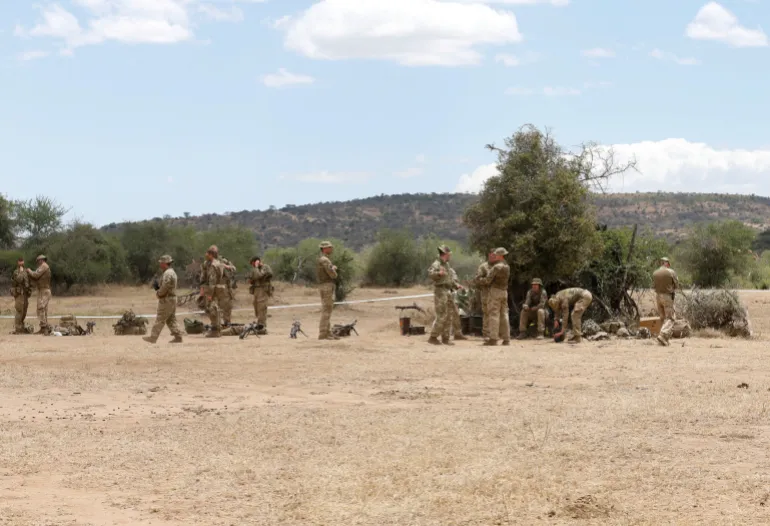
A Kenyan parliamentary report has accused British troops training in the country of killings, sexual, human rights and environmental abuses, following years of accumulated complaints from local communities.
The report, published on Wednesday, found that serious misconduct by British soldiers caused them to be viewed as something of an “occupying force” by local people.
For the past 60 years, British soldiers in the British Army Training Unit in Kenya (BATUK) have routinely trained in the East African nation, favoured for its temperate weather and realistic combat scenarios. However, they have attracted rising numbers of accusations of gross violations, ranging from killings to neglectful disposal of military grade chemicals. The most notorious case was the murder of a 21-year-old Kenyan woman, Agnes Wanjiru, which gained international media attention.
Community activists who have for years sought redress in Kenyan courts told Al Jazeera the report’s publication represented an “enormous victory” not just for Kenya, but for other African countries which host foreign military bases on their territory, but are wary of regulating them.
“The Kenyan parliament has demonstrated that the British Army is not above the law,” said James Mwangi, founder of the grassroots advocacy group, Africa Centre for Corrective and Preventive Action (ACCPA), which has been at the forefront of bringing community grievances to Kenyan courts, and which advised lawmakers during their investigation.
“The impunity that has been perpetrated by these forces has been appalling. The world has seen that African parliaments can take measures to combat injustices by these forces, and Kenya has become the first country in Africa to do such a thing,” he added.
BATUK (British Army Training Unit in Kenya) is a permanent training force based in Nanyuki, central Kenya. It has been stationed there since Kenyan independence from the UK in 1963 and has about 100 permanent staff and some 280 rotating short-term troops from the United Kingdom.
The unit trains British troops and provides anti-terrorism training for Kenyan troops fighting the al-Shabab armed group, as agreed in the UK-Kenya Defence Cooperation Agreement, which, since 2015, allows both armies to share intelligence and training.
In 2022, the UK government reported that BATUK had contributed more than 5.8 billion Kenyan shillings ($45m) to the local economies in which its garrisons are based, and that it employed more than 550 local staff. Local businesses close to BATUK training sites also benefit from the unit’s presence, it said.
However, there have been numerous complaints from local people about the conduct of the troops. They say mishandling of dangerous training material and unexploded bombs left in the ground have caused serious injuries, and they have complained about how British soldiers behave towards Kenyan women in the area.
Many Kenyan women say they have been left to care for children alone after British soldiers they began relationships with left the country at the end of their training.
There has been no mechanism within the UK or Kenyan justice systems to hold British soldiers under BATUK to account. On that basis, the UK government initially pushed back against Kenyan authorities’ attempts to investigate the troops’ behaviour.
In April 2024, therefore, the Kenyan parliament voted to amend the defence agreement with the UK to allow for local prosecutions of British soldiers.
© 2025 INTERNATIONAL HUMAN RIGHTS MONTHLY. ALL RIGHTS RESERVED | Privacy Policy
Adding {{itemName}} to cart
Added {{itemName}} to cart